

|
Let’s begin with a question. When ?17 (n) is divided by 7 (d), what is the quotient and the remainder?
|
We already know from earlier lessons that n, d, quotient, and remainder must be integers such that remainder ? 0 and d ? 0.
Whereas, n and quotient can be any integers (positive, negative, or zero).
In the above question, n = -17, d = 7
The goal is to find a value for the quotient such that 0 ? Remainder < d
Let’s begin by taking the quotient to be equal to 1….
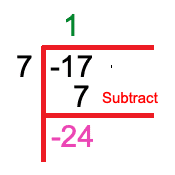
By taking the quotient to be equal to 1, the remainder is -24.
Since 0 ? Remainder < d, the quotient cannot be 1.
What if we take the quotient to be equal to 2….
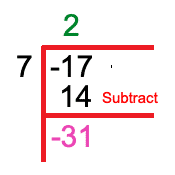
We can see that this also gives us a negative remainder.
Clearly, +ve values of the quotient fail to provide us with the correct remainder.
So then, let’s take quotient = 0….
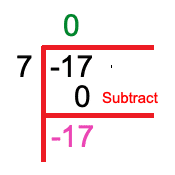
Again, the remainder is negative.
So then, let’s move on to test some negative values for the quotient.
We can begin by taking Quotient as equal to ?1….
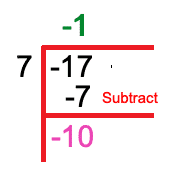
Gosh…. again we are getting a negative remainder.
But, a ray of hope….
Observe that the remainder is less negative than the other cases we discussed previously.
Then let’s take another negative value.
Take Quotient = ?2….
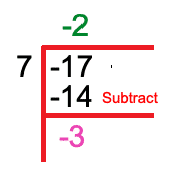
The remainder is getting less and less negative.
Put Quotient = ?3….
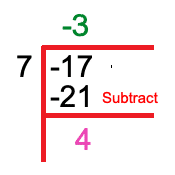
Finally, we got a remainder that satisfies: 0 ? Remainder < d.
What if we take Quotient = ?4?….
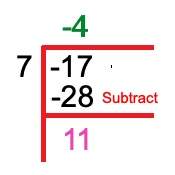
By taking the quotient = ?4, we do get a remainder that is positive.
However, this remainder (11) is greater than d (7).
Since 0 ? Remainder < d, we cannot take the quotient to be ?4.
Therefore,
n = -17, d = 7 ? Quotient = -3, Remainder = 4
To summarise,
if the d < 0 ? Quotient < 0
|
Now try this: What is the remainder when -427 is divided by 903? |
Since n is negative, therefore the quotient must be negative.
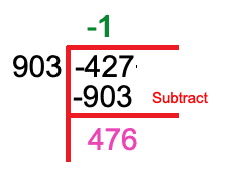
By taking the quotient = ? 1, we get a remainder (476), which is less than d (903) and also ? 0.