

Standard deviation is an important statistical term tested on the GRE. It gives you an insight into the deviation or dispersion of a set of numbers from its mean; therefore, a low standard deviation implies that the numbers are very close to the mean, and vice versa.
On Math, there is a complex formula to calculate the standard deviation of a set of numbers and it is as follows:
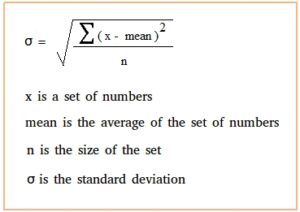
Let me elaborate this formula. The standard deviation of a group of n numbers is computed by (1) calculating the mean of the n values, (2) finding the difference between the mean and each of the n values, (3) squaring each of the differences, (4) finding the average of the n squared differences, and (5) taking the nonnegative square root of the average squared difference.
99% chance is, on the GRE Math, this formula will not be tested. But still, you should know this method of calculating standard deviation.
GRE problems will most likely test your conceptual knowledge of what standard deviation is, i.e., a measure of how closely knitted or dispersed a data set is.
Let’s understand this with an example: We have three numbers {10, 20, 30} and let’s presume that these numbers have a standard deviation of 8.2. Which of the following is the best approximation of the standard deviation of {11, 12, 13}?
- 0.82
- 8
- 2
It may look as if this question requires you to calculate the value of the standard deviation, but it’s not the case. All you need to know is that standard deviation is the dispersion from the mean.
For {10, 20, 30}, the mean is 20, and each of the farthest members is 10 away from the mean. For {11, 12, 13}, the mean is 12, and the farthest members are 1 away from the mean. The numbers {11, 12, 13} are therefore less dispersed around the mean than are the numbers {10, 20, 30}. Hence, the standard deviation of {11, 12, 13} must be smaller than 8.2. The only answer choice that is less than 8.2 is 0.82.
On the GRE if you are asked to compare the standard deviations of set’s of number, then here is a quick way.
Find the average distance (positive) of each value from the mean.
The numbers 11, 12, 13 are 1, 0, and 1 units away from the mean respectively. The average of 1, 0 and 1 is (1 + 0 + 1)/3 = 2/3. This is close to the actual answer of 0.82.
Similarly, the numbers 72, 74, 76 are 2, 0, and 2 units away from the mean, respectively. The average of 2, 0, and 2 is (2 + 0 + 2)/3=4/3.
Hence, standard deviation of 72, 74, and 76 is more than the standard deviation of 11, 12, and 13.
Standard deviation can never be negative since we use distance (positive) to calculate it. Standard deviation can be 0 in case all the numbers are equal to each other. For example, if a set of numbers with a mean of 15 has a standard deviation = 0, then all of that set’s members will be equal to 15.
To summarize:
- The standard deviation tells you about the deviation or dispersion of a set of numbers.
- A low standard deviation implies that the numbers are very close to the mean.
- A high standard deviation indicates that the numbers are “dispersed” over a large range of values.
- Standard deviation = 0 means all values are the same.
- Standard deviation can never be negative.