

Every integer greater than 1 either is a prime number or a composite number.
All composite numbers can be expressed as a product of prime numbers.
For example,
6 can be expressed as 2 × 3. The prime factors of 6 are 2 and 3. Whereas the expression 2 × 3 is called prime factorization.
Another example,
24 can be expressed as 2 × 2 × 2 × 3. The prime factors of 24 are 2 and 3. Whereas the expression 2 × 2 × 2 × 3 is called prime factorization.
Similarly, 45 = (3)(3)(5). The prime factors of 45 are 3 and 5. Whereas the expression 3 × 3 × 5 is called prime factorization.
The factor tree is a basic technique for finding the prime factors of any integer.
The technique goes as follows:
1) Divide the original integer by the smallest possible prime number: 2. If the integer is not divisible by 2, try dividing by the next smallest prime: 3, then 5, etc. Write the prime on the left side of the tree, the result of the division on the right.
2) If the result is not prime – continue dividing by the smallest possible prime number, marking primes on the left, results on the right.
3) Repeat the process until the result of the last division is prime – then stop.
4) Circle the left-and-bottom-most integers on the tree – these are the prime factors of the original integer. The original integer is equal to the product of these prime factors, and that product is called the prime factorization of the original integer.
Let’s look at a simple example: What are the prime factors of 18?

Since 9 is not divisible by 2, we’ll divide it by the next largest integer: 3. Write 3 on the left side of the tree. The result of 9/3 is also 3, which is prime, so write 3 on the right as well, then stop.
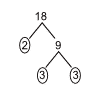
Voila! The prime factorization of 18 is 2•3•3.
For larger integers, it’s better to begin the process with numbers larger than 2. You can start with whatever product of integers you like that multiplies to the original integer as the following example for prime factorization of 210 illustrates:

The prime factors of 210 are the numbers at the ends of the branches (circled in the tree): [2, 3, 5, 7]. The prime factorization of 210 is 2•3•5•7.