

Some basic math terminology:
+ represents sum or addition
– represents difference or subtraction
× or • represents product or multiplication
÷ or / represents a division
[] or () represents brackets or parenthesis
| Be careful not to confuse (parentheses) or [brackets] with |absolute value bars|. They are not the same symbols, and different rules apply for evaluating them. We will discuss |absolute value bars| later on. |
Mathematical “Operations” mean things like add, subtract, multiply, divide, squaring, etc.
But, when you see something like …
7 × 9 + (2 × 52 – 3 ÷ 6 × 14)
What part should you calculate first?
So, long ago people agreed to follow some rules when doing calculations, and they are:
Do things in Parentheses First
4 × (5 + 3) = 4 × 8 = 32 (right)
4 × (5 + 3) = 20 + 3 = 23 (wrong)
Exponents (Powers, Roots) before Multiply, Divide, Add or Subtract
5 × 22 = 5 × 4 = 20 (right)
5 × 22 = 102 = 100 (wrong)
Multiply or Divide before you Add or Subtract
2 + 5 × 3 = 2 + 15 = 17 (right)
2 + 5 × 3 = 7 × 3 = 21 (wrong)
How Do I Remember It All … ? PEMDAS!
| P | Parentheses first |
| E | Exponents |
| MD | Multiplication and Division (they both have the same rank and if they come together, then solve from left to right) 30 ÷ 5 × 3 = 6 × 3 = 18 (right) 30 ÷ 5 × 3 = 30 ÷ 15 = 2 (wrong) |
| AS | Addition and Subtraction |
| In the UK they say BODMAS (Brackets, Orders, Divide, Multiply, Add, Subtract), and in Canada, they say BEDMAS (Brackets, Exponents, Divide, Multiply, Add, Subtract). It’s also known as DMAS (Divide, Multiply, Add, Subtract). It all means the same thing! |
Just remember that although multiplication comes before division in this Abbreviation, the two have the same rank. What PEMDAS tells us is that “Multiplication and Division” must be done before “Addition and Subtraction”.
For instance,
35 ÷ 5 + 2 × 6 is equal to
(35 ÷ 5) + (2 × 6) = 19
and not equal to
35 ÷ (5 + 2) × 6 = 35 ÷ 7 × 6
When you have a bunch of operations of the same rank (Multiplication and Division), you just operate from left to right. For instance,
35 ÷ 7 × 6
is not
35 ÷ (7 × 6) = 35 ÷ 42,
but is rather
(35 ÷ 7) × 6 = 5 × 6 = 30,
because going from left to right, you get to the division sign first.
Let’s revisit the last example we discussed:
35 ÷ 7 × 6 = 30
In this problem, we solved in the order of appearance i.e. from left to right. We first divided 35 by 7, which resulted in 5. Then we multiplied 5 with 6 to get 30.
We can redo this question by actually turning the division (÷) sign into a multiplication (×) sign.
The way to do this is by turning the number after the division sign upside down and changing the division symbol to a multiplication symbol.

In this case, we turned 7 upside down. We can now simply the expression to get the same result as we got before.
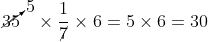
Be careful. Sometimes one can make the mistake of flipping everything after the division symbol.

This would have been correct if there were a parenthesis, like this 35 ÷ (7 × 6). This would have then become

7 × 9 + (2 × 52 – 3 ÷ 6 × 14)
To summarize:
- Multiplication and Division come before Addition and Subtraction
- Multiplication and Division have the same rank
- If Multiplication and Division come together
- then solve from left to right or,
- replace division with multiplication and flip the number that comes after the division