

19 ÷ 5 can be viewed in many different ways, depending on what the question asks.
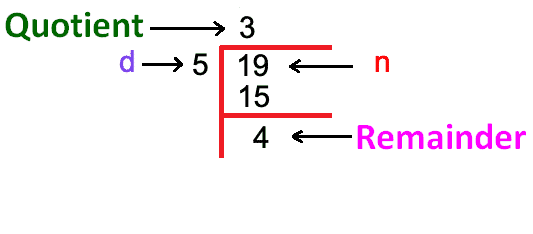
It can be viewed as a Simple Fraction, i.e. 19/5, which can be solved using the long division to get the quotient of 3 and the remainder of 4.
….or it can be viewed as a mixed fraction

Oops. I forgot how to convert from a simple to a mixed fraction
Example: Convert 19 ÷ 5 to a mixed fraction.
Divide: 19 ÷ 5 = 3 quotient, 4 remainder.
Write down the quotient (3) and then write down the remainder (4) above d (5).

Forgot how to convert from a mixed to a simple fraction?
Multiply the quotient (3) with d (5): 3 × 5 = 15
Then add the remainder: 15 + 4 = 19
Then write that result above d: 19/5
….or it can be viewed as the sum of an integer and a fraction

Algebraically, this can also be generalized as:

….and finally, 19 ÷ 5 can be viewed as a decimal as well.
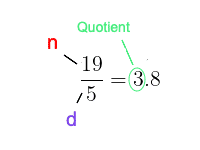
We know that the quotient is the integer portion of the decimal. So, 3 is the quotient.
But how can we find the remainder from the decimal value 3.8?….
Well, it’s pretty simple. The integer portion (3) of 3.8 gives us the quotient.
Naturally, the decimal portion (0.8) of 3.8 should give us the remainder.
But how can we extract the remainder from the decimal portion (0.8)?….
First, split 3.8 as ? 3 + 0.8
Next, write the decimal portion as a fraction and simplify it.

You can see that we have rewritten the decimal value as the sum of an integer (quotient) and a fraction (remainder ÷ d) that we had earlier discussed.
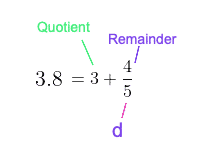
Based on this, we can also say that the decimal portion (0.8) = Remainder ÷ d
Now we can generalize this as,
Decimal portion = Remainder ÷ d
Let’s look at some examples
19/5 ? Quotient 3, Remainder 4
38/10 ? Quotient 3, Remainder 8
57/15 ? Quotient 3, Remainder 12
76/20 ? Quotient 3, Remainder 16
95/25 ? Quotient 3, Remainder 20
Observe that all of the fractions in the previous question were equivalent fractions (they are all equal to 3.8)


I forgot! What are equivalent fractions?
Equivalent Fractions have the same value, even though they may look different.
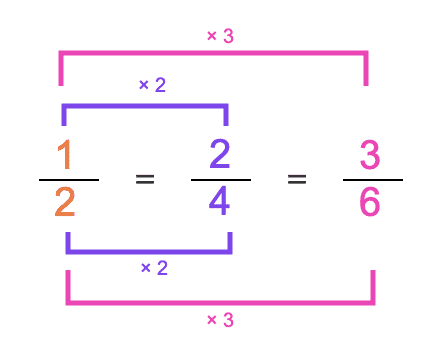
For example: 1/2 = 2/4 = 3/6
Why are they the same? Because when you multiply or divide both the numerator and denominator of a fraction by the same number, the fraction keeps its value.
Here are some extremely important findings of equivalent fractions.
| Equivalent Fractions | Quotient | Remainder | n | d |
|---|---|---|---|---|
| 19/25 | 3 | 4 | 19 | 5 |
| 38/10 | 3 | 8 | 38 | 10 |
| 57/15 | 3 | 12 | 57 | 15 |
| 76/20 | 3 | 16 | 76 | 20 |
| 95/25 | 3 | 20 | 95 | 25 |
| All quotients are the same (3) | All remainders are multiples of the smallest remainder (4) | All values of n are multiples of the smallest value of n (19) | All values of d are multiples of the smallest value of d (5) |
The smallest values of n, d, and remainder were derived from the most simplified fraction 19/5.
|
Which of the following cannot be the remainder of the decimal 2.75? Select all that apply.
|
We know that the decimal portion (0.75) of 2.75 will give us the remainder.
Let’s split 2.75 as ? 2 + 0.75
Now write the decimal portion as a fraction and simplify.
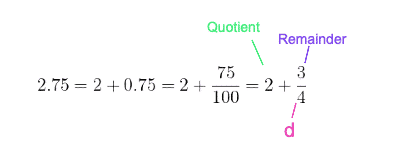
By the looks of it, you might think that 3 should be the remainder then.
But there is a problem
In the question, we are not given the fraction that resulted in 2.75.
What does that mean?
It means that 2.75 could be the result of 275/100 (remainder 75).
or 2.75 could be the result of 22/8 (remainder 6)
or the result of 88/32 (remainder 24) ….
We simply don’t know the origins of 2.75. In other words, from which fraction did 2.75 come from.
Earlier we discussed that equivalent fractions have different remainders. So unless we don’t know the exact equivalent fraction of 2.75, we cannot give an exact value for the remainder.
The same concept applies here as well
All of the following fractions are equivalent to 2.75 but have different remainders.
2 + 3/4 or 11/4 = 2.75 (Remainder = 3)
2 + 6/8 or 22/8 = 2.75 (Remainder = 6)
2 + 9/12 = 33/12 = 2.75 (Remainder = 9)
.
.
.
.
This clearly shows that there are infinite possible values of the remainder of 2.75.
The smallest possible remainder is 3 (derived from the most simplified fraction 2 + 3/4 = 11/4) and the other remainders are multiples of 3, i.e. 3, 6, 9, 12, 15, ….
Coming back to the options: 3, 24, 30, and 54 are all multiples of 3 and therefore can be the possible remainders of 2.75.
61, however, is not a multiple of 3 and therefore it cannot be the remainder of 2.75.
Additional Note
To find the exact fraction that gives a remainder of 24, what should we do?
We already know that the most simplified fraction equivalent to 2.75 is 2 + 3/4 (11/4), where 3 is the remainder.
To get a remainder of 24, we need to replace 3 with 24.
How can we get a 24 in place of 3?
By multiplying and dividing the fraction by 8.

Summary:
- n ÷ d = Quotient + Remainder ÷ d
- Equivalent fractions have the same quotient, but different remainders, n, and d.
- For fractions (either simple or mixed), you can find the exact value of the remainder.
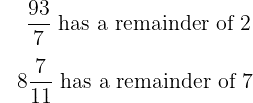
- For decimal values, if you don’t know the fraction, the remainder has infinite values.
- The values of the remainder are multiples of the smallest remainder, which can be found from the most simplified fraction.

The smallest remainder is 7 and the other remainders should be multiples of 7, i.e. 7, 14, 21, 28, 35, ….