

Like most people who take the GRE, your Math knowledge might be a little rusty. The good news is that GRE only tests you on math that you have already learned in high school. If you are worried that you have forgotten most of what you learned in high school, you will be surprised how quickly it will all come back.
Geometry is one of the four math areas tested on the GRE. You can expect to find 6-10 geometry questions on the revised GRE. Fortunately, most geometry topics that are tested on GRE are not that difficult. You will be thrilled to know that there are no questions regarding theorems or constructing proofs on GRE.
The major Geometry topics tested on GRE are as follows:
- Parallel and perpendicular lines
- Circles
- Triangles — including isosceles, equilateral and 30°-60°-90° triangles
- Quadrilaterals
- Congruent and similar figures
- Three-dimensional figures
- Area
- Perimeter
- Volume,
- The Pythagorean theorem
- Angle measurement in degrees
However, in this article, I will start out with the most basic Geometry component – The Triangle.
What is a Triangle?
Let’s start at the very beginning. What exactly is a triangle? To answer that, we need to first address what a polygon is.
A polygon is a plane figure that is constructed by joining multiple straight lines end-to-end. You have probably made them when you were lost in thought, mindlessly scribbling away during a lecture. All you need to do is simply join straight lines, and you get a polygon.
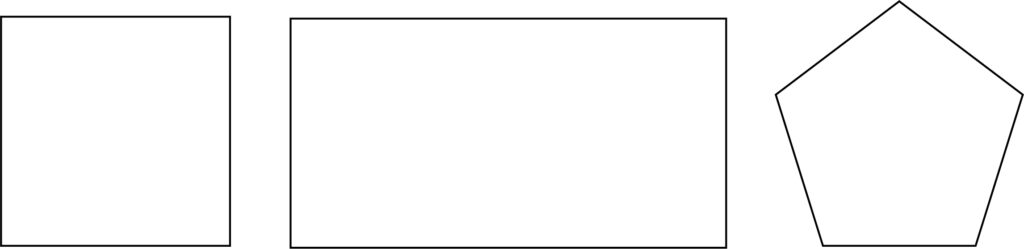
Figure 1: A square, a rectangle, and a pentagon are all examples of a polygon
However, the least amount of lines that you could draw to make a polygon are three. The polygon you get from joining three straight lines is called a triangle.
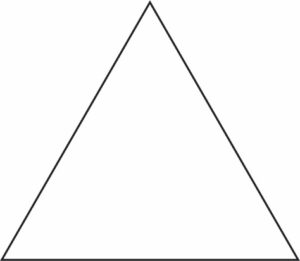
Figure 2: An equilateral triangle
In other words, a triangle is a polygon with three sides, three angles, and three vertices. A vertex is a point where two lines meet.
Fundamental Properties of a Triangle
The easiest way to understand triangles is by first learning the basic properties or “rules” of a triangle.
The sum of the length of any two sides of a triangle is greater than the length of the third side.
The shortest distance between any two points is always a straight line. Due to this, we know for a fact that if we add the length of any two sides of a triangle, the result will be greater than the length of the remaining third side. Conversely, the length of the third side will always be greater than the difference of the other two sides.
Consider the following figure:

Figure 3: x can neither be greater than the sum of the other two sides nor smaller than the difference
See how the triangle ceases to be when X’s value is either greater than 3+5 or smaller 5-3. Hence,
X must always be less than 3+5=8 and,
X must always be greater than 5-3=2
So, 2 < x < 8
The sum of all internal angles of a triangle is always equal to 180 °
This rule states that the three interior angles of a triangle must always add up to 180 °. Knowing this can allow you to infer the angle of unknown size. For example, if you know the measure of two angles of a given triangle, you can determine the third angle.
Consider the following triangle:
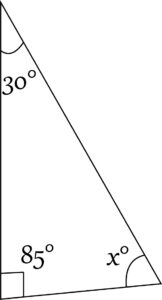
Figure 4: The sum of the three angles of a triangle must always be equal to 180°
Since we know that the three angles of a triangle must always add up to 180 °. We can calculate the angle of X by
30 + 85 + x = 180
X= 65
Hence, the third angle is 65 °.
GRE can also test your knowledge of this in more complicated ways. Such as:
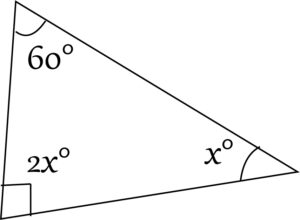
Figure 5: Here, only one angle is given
In the triangle above, you are given only one angle. The other two are given in terms of X. However, we know that the three angles add up to 180°. Hence,
60 + 2x + x = 180
3x= 180-60
x= 120/3
x= 40
Thus, the angle x is 40° and 2x is 80°.
Do note that GRE does not draw triangles to scale, so don’t try to judge the angles or length of the sides from the picture. Always solve mathematically instead.
The side opposite to the largest angle of a triangle is the largest side, and the side opposite to the smallest angle is the smallest side.
A good way to think about this rule is to imagine an alligator opening its mouth. The bigger the mouth opens (angle), the greater the distance between its upper and lower front teeth becomes (size of the side). Check the figure below for:
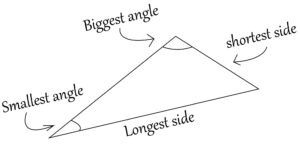
Figure 6: The side opposite smallest angle is the shortest side, and the side opposite the biggest angle is the longest side
This rule is extremely useful because it works both ways. If you know the angles of a triangle, you can make inferences about the sides, and if you know the sides, you can make inferences about the angles.

Figure 7: Relationship between sides and angles
While it is true that you can determine which sides are longer or shorter opposite to an angle, you cant determine how much longer or shorter they are. For example, consider the top triangle in fig. 7, <BAC is twice as large as <ABC, but the does not indicate that side BC is twice as long as side AC.
In other words, the measure of an angle is not directly proportional to the size of the opposite side.
Things get particularly interesting when a has the same length sides or angles of the same measure. This is where the different types of triangles come into play.
Types of Triangles
Although there are six types of triangles, we are only concerned with two at the moment. The isosceles triangle and the equilateral triangle.
Isosceles Triangle
A triangle that has two equal angles and two equal sides opposite the equal angles is called an isosceles triangle.
Equilateral Triangle
A triangle that has three equal angles (each angle at 60°) and three equal-length sides is called an equilateral triangle.

Figure 8: Isosceles triangles
In the figure above, you can see two isosceles triangles. Both the triangles have equal opposing sides and angles. It is important to remember that this relationship between equal angles and equal sides works in both directions.
You will see a lot of isosceles triangles in your GRE prep as well as the real test. However, GRE would often present these triangles in a more challenging application. Consider the following figure:

Study the above triangle for a bit and see what other information you can fill in. Particularly, can you determine the degree measure of either <BAC or <ACB?
As you already know, side AB is the same length as BC because it’s an isosceles triangle, which means that <BAC has the same degree measure as <ACB ( equal-sides equal-angles rule).
Let’s label each of these unknown angles as x° on our diagram:
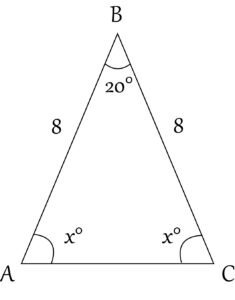
Since we already know that all three internal angles of a triangle will add up to 180°. Hence,
x + x + 20 = 180
2x+20= 180
2x= 180-20
x= 160/2
x= 80
thus, <BAC and <ACB each equal 80°.