

|
Let’s begin by solving 29 ÷ 11. |

Note that 29 = 11 × 2 + 7
This can be generalized as
n = d × quotient + remainder (a very important relation tested)
We can also write that:
- 29 is 7 more than 22, or that
- 29 is 7 more than a multiple of 11 (since 22 is a multiple of 11).
In other words, we can interpret 29 = 11 × 2 + 7 as a multiple of 11, plus 7.
As a general rule, you can simply say that n can be found by adding the remainder to a multiple of d.
n = d × quotient + remainder
is the same as
n = multiple of d + remainder
Knowing this is important because some questions require you to find n based on a certain value for d and the remainder.
For example, find n such that n gives a remainder of 7 when divided by 11.
Here, d is 11, and the remainder is 7.
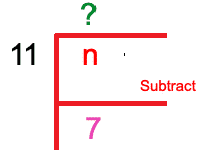
To solve this question we can use any one of these two relations:
n = d × quotient + remainder
n = multiple of d + remainder
Let’s use both to get the concept right….
Let’s start by using the first relation
n = d × quotient + remainder
x = 11 × quotient + 7
Recall that the quotient is an integer.
So the possible values of the quotient are {….-4, -3, -2, -1, 0, 1, 2, 3, 4….}
Based on this, the values of n can be:
| n = 11 × quotient + 7 | Quotient |
|---|---|
| …. | …. |
| 11 × (-4) + 7 = -37 | -4 |
| 11 × (-3) + 7 = -26 | -3 |
| 11 × (-2) + 7 = -19 | -2 |
| 11 × (-1) + 7 = -4 | -1 |
| 11 × (0) + 7 = 7 | 0 |
| 11 × (1) + 7 = 18 | 1 |
| 11 × (2) + 7 = 29 | 2 |
| 11 × (3) + 7 = 40 | 3 |
| 11 × (4) + 7 = 51 | 4 |
| …. | …. |
The second relation was: n = multiples of d + remainder
n = multiples of 11 + 7
Multiples of 11 are:
…. ?44, ?33, ?22, ?11, 0, 11, 22, 33, 44 ….
| n = 11 × quotient + 7 | Multiples of d (11) |
|---|---|
| …. | …. |
| -44 + 7 = -37 | -44 |
| -33 + 7 = -26 | -33 |
| -22 + 7 = -15 | -22 |
| -11 + 7 = -4 | -11 |
| 0 + 7 = 7 | 0 |
| 11 + 7 = 18 | 11 |
| 22 + 7 = 29 | 22 |
| 33 + 7 = 40 | 33 |
| 44 + 7 = 51 | 44 |
| …. | …. |
Now, coming back to the original question: Find n such that n gives a remainder of 7 when divided by 11?
So, the possible values of the n are…
n = {…. -37, -27, -15, -4, 7, 18, 29, 40, 51, ….}
There are some important observations that can be deduced and generalized:
- The possible values of n are infinite.
- The smallest positive value of n is equal to the remainder (in this case 7).
{…. -37, -27, -15, -4, 7, 18, 29, 40, 51, ….} - The difference between any two consecutive values of n is equal to d (in this case 11). For example,
- The difference between 51 and 40 is 11.
- The difference between 18 and 7 is 11.
- The difference between 7 and -4 is 11.
- and so on….
In summary,
- You can use these two equations interchangeably
- n = d × quotient + remainder
- n = multiple of d + remainder
- The difference between any two consecutive values of n is equal to d.
- The smallest positive value of n is equal to the remainder.
- The possible values of n are infinite.
Now try this:
Given that x is an integer greater than -40 but less than 50. When x is divided by 13, the remainder is 12. How many values does x have?
n = multiple of d + remainder
Since we have a choice, we will use the second equation. But it is entirely up to you to choose between them.
n = multiple of d + remainder
In this question, d is 13 and remainder is 12.
So let’s put down a few multiples of 13.
{….,?65, ?52 , ?39, ?26, ?13, 0, 13, 26, 39, 52, 65, ….}
Now add 12 to each one of these….
?65 + 12 = ?53
?52 + 12 = ?40
?39 + 12 = ?27
?26 + 12 = ?14
?13 + 12 = ?1
0 + 12 = 12
13 + 12 = 25
26 + 12 = 38
39 + 12 = 51
52 + 12 = 64
65 + 12 = 77
Of these, we will only select those that are between ?40 and 50.
?27, ?14, ?1, 12, 25, 38
i.e. 6 values.
In the previous question, we could have saved a lot of time by using the following approach.
We know that “The difference between any two consecutive values of the n is equal to the ?.”
Let’s apply this.
First find any one value of n. Let’s say you find n = 12.
Now simply add d (13) to this value to get the next value of n.
12 + 13 = 25
Keep adding….
25 + 13 = 38
add again….
38 + 13 = 51 …. stop (we have to stay below 50)
To find the smaller values of n, start subtracting the d (13) from n = 12.
12 – 13 = -1
subtract again….
-1 – 13 = -14
again….
-14 – 13 = -27
one more time….
-27 – 13 = -40…. stop (we have to stay above -40)