

When an integer n is divided by a nonzero integer d, the quotient refers to the integer part of the result.
For instance, when 300 (n) is divided by 15 (d), the result is 20.
The quotient is 20 and the remainder is 0.
Also written as 300 ÷ 15 = “20 Remainder 0” or “20 R 0”
On mathematics, n is also known as the dividend but the question never uses the term dividend.
Let’s do another example:
300 ÷ 7 = 42.8571.
Here, n = 300 and d = 7. The integer part of the result is 42. Hence 42 is the quotient.
(Note that quotient is the integer part of the result.)
We can also find the quotient by using the long division.
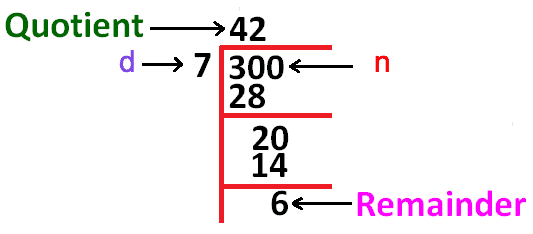
300 ÷ 7 = 42 (6). The quotient is 42, while the remainder is 6.
Denoted as “42 R 6”
In remainder problems, on the question:
- n must be an integer,
- d must be a non-zero integer, d ? 0
- the quotient must be an integer,
- the remainder must be a non-negative integer, i.e. remainder ? 0
These conditions are strictly followed by the questions.
|
What is the quotient of 5/8? When we divide 5/8, the result of the division is 0.625. The integer part of this value is 0, which is the quotient. |
|
What is the quotient of -15 ÷ 6? When we divide -15 by 6, the result of the division is -2.5. The integer part of this value is -2, which is the quotient. |
|
What is the quotient of 12.75? The integer part of 12.75 is 12, which is the quotient. |