

Positive: any number that is greater than zero.
For example, 0.5, 3/4, 5, 190, 908.9
It may also be written with a “+” in front, like +5.
The word “positive” can be shortened to “+ve”.
Negative: any number that is smaller than zero.
For example, -0.25, -7/8, -1, -10.75, -1000
A negative number is always written with a minus sign in front.
The word “negative” can be shortened to “−ve”.
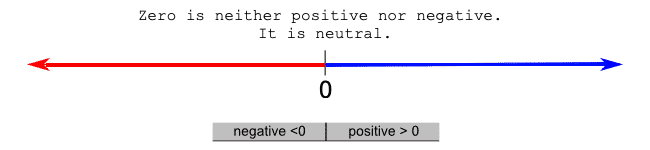
Zero is neutral – neither positive nor negative.
As an illustration, we can draw a number line where positive numbers are to the right of zero and negative numbers are to the left:
|
Which of the following are positive numbers?
Solution: The question asks about numbers, i.e. real numbers. Numbers that are greater than zero are positive. Only 19.99 and 27 are numbers greater than zero. -57 and -9.89 are negative numbers. 0 is neither positive nor negative. It is neutral. |
|
Which of the following are negative integers?
Solution: Be careful here. Unlike the previous question, this question is asking you to choose integers Of the given options, only −57, 0, and 27 are integers. And of these, −57 is the only negative integer. So watch out. The GRE loves to trap test-takers with these subtle differences. When the GRE says
|
Is non-negative the same as positive?
“Non-negative” simply means not negative.
For example, take the following set of numbers….
{… −5.9, −3, −2.75, −1, −0.82, 0, 1.25, 2.9, 3.5, 14, 25, …} (-ve, zero, +ve)
….and throw out all the negative elements. What you are left with is the set:
{0, 1.25, 2.9, 3.5, 14, 25, …} (zero, +ve):
and that set is the set of non-negative numbers.
In short non-negative includes zero whereas positive does not.
| Non-negative ≥ 0 | Positive > 0 |
The same goes for “non-positive”, which is not the same as “negative”:
Non-positive includes zero whereas negative does not.
| Non-positive ≤ 0 | Negative < 0 |
|
If x is non-negative and also non-positive, which of the following must be true?
Solution: Zero is the only number that is neither positive nor negative. Hence the correct answer is (A). What if the question was: If x is negative and also positive, which of the following must be true?
….the answer to this problem would have been (B). There is no number that is positive and negative at the same time. |
|
Which of the following is non-negative?
Solution: Since the question asks us about non-negative values, we will choose all numbers that are ≥ 0. Note that the question does not specify integers. Therefore, we will choose all numbers, integers or not. |
Observe that in the last question, it said: Which of the following is non-negative?
You might think non-negative what? integer, fraction, number (real number) …?
Know this: If the test does not specify the number type, then assume it to be a real number.
In other words, these two are equivalent statements.
- Which of the following is non-negative?
- Which of the following is a non-negative number?
|
Which of the following is a non-negative integer?
Again be careful here. Since the question asks us about non-negative integers, we will choose all integers that are ≥ 0. |