
What are Prime Factors?

Every integer greater than 1 either is a prime number or a composite number. All composite numbers can be expressed as a product of prime numbers. For example, 6 can…

Every integer greater than 1 either is a prime number or a composite number.

All composite numbers can be expressed as a product of prime numbers.

For example,

6 can be expressed as 2 × 3. The prime factors of 6 are 2 and 3. Whereas the expression 2 × 3 is called prime factorization.

Another example,

24 can be expressed as 2 × 2 × 2 × 3. The prime factors of 24 are 2 and 3. Whereas the expression 2 × 2 × 2 × 3 is called prime factorization.

Similarly, 45 = (3)(3)(5). The prime factors of 45 are 3 and 5. Whereas the expression 3 × 3 × 5 is called prime factorization.

The factor tree is a basic technique for finding the prime factors of any integer.

The technique goes as follows:

1) Divide the original integer by the smallest possible prime number: 2. If the integer is not divisible by 2, try dividing by the next smallest prime: 3, then 5, etc. Write the prime on the left side of the tree, the result of the division on the right.

2) If the result is not prime – continue dividing by the smallest possible prime number, marking primes on the left, results on the right.

3) Repeat the process until the result of the last division is prime – then stop.

4) Circle the left-and-bottom-most integers on the tree – these are the prime factors of the original integer. The original integer is equal to the product of these prime factors, and that product is called the prime factorization of the original integer.

Let’s look at a simple example: What are the prime factors of 18?

Since 9 is not divisible by 2, we’ll divide it by the next largest integer: 3. Write 3 on the left side of the tree. The result of 9/3 is also 3, which is prime, so write 3 on the right as well, then stop.
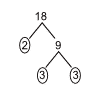
Voila! The prime factorization of 18 is 2•3•3.


For larger integers, it’s better to begin the process with numbers larger than 2. You can start with whatever product of integers you like that multiplies to the original integer as the following example for prime factorization of 210 illustrates:

The prime factors of 210 are the numbers at the ends of the branches (circled in the tree): [2, 3, 5, 7]. The prime factorization of 210 is 2•3•5•7.


SEE ALSO

GRE Math: Fundamentals of a Triangle

Like most people who take the GRE, your Math knowledge might be a little rusty. The good news is that GRE only tests you on math that you have already learned in high school. If you are worried that you have forgotten most of what you learned in high school, you will...

read more

How do you Calculate Standard Deviation on the GRE?

Standard deviation is an important statistical term tested on the GRE. It gives you an insight into the deviation or dispersion of a set of numbers from its mean; therefore, a low standard deviation implies that the numbers are very close to the mean, and vice versa....

read more

How to calculate Factors of Perfect Squares

Let's see how we use the chart to deal with this question: How many positive factors does 100 have? Set up the chart: 100 Left Column Right Column 1 100 2 50 4 25 5 20 10 10   Remember the rule - once the factors repeat themselves, (i.e. 10 and 10), stop. Since...

read more

What are Factor Tables?

Some integer questions may require you to find the Factors of an integer. The factor table is a basic technique for finding all the factors of any integer. This technique can also be useful for questions asking how many factors a particular integer has. The technique...

read more

Basics of Prime Numbers

Primes play a central part in integer questions. Overconfidence is dangerous here: while almost everybody can recite the definition of a prime number at the drop of a hat, the field is actually rife with misconceptions. We are here to make sure you know everything...

read more

Rules of Operations for Odd and Even Numbers

Let's formulate rules for addition, subtraction, multiplication, and division of Even and Odd numbers. Here are the rules for adding / subtracting even and odd numbers: Even ± Even = Even (e.g. 2 + 2 = 4; -4 - 2 = -6) Odd ± Odd = Even (e.g. 1 + 1 = 2; -31 - 1 = -32)...

read more

Basics of Even & Odd numbers

We'll begin with the basic definitions: Even: any integer that is divisible by 2. Examples: 2, 4, 14. Odd: any integer that is not divisible by 2, i.e. leaves a remainder of 1 when divided by 2. Examples: 1, 3, 5, 7, 9 So far so good. Consider this potential...

read more

Shortcuts to find Remainders

Find the remainder when 5,142,376,298 is divided by 9?     The long division method will definitely tell you the remainder of dividing 5,142,376,298 by 9 but you can very well imagine how long would that take. The good news is that just like the divisibility...

read more

Divisibility Rules

Is 5,142,376,298 divisible by 3? A calculator would come in handy for this question. Unfortunately, the calculator displays up to eight digits. If a number is greater than eight digits, then ERROR will be displayed. Since 5,142,376,298 is greater than the eight...

read more