

The term “critical thinking skills” means being able to use logic and reasoning to evaluate information, arguments, or claims in an objective manner. These skills help people recognize biases, assumptions, and fallacies in arguments, and determine the credibility and importance of presented evidence. To think critically, the students must have an open mind, be skeptical and curious. Students are recommended to look at different perspectives and explanations before decision making. Critical thinking skills are important for students to make informed choices, solve difficult problems, and make good decisions in everyday life, school, and work.
Why students have problems with critical thinking skills
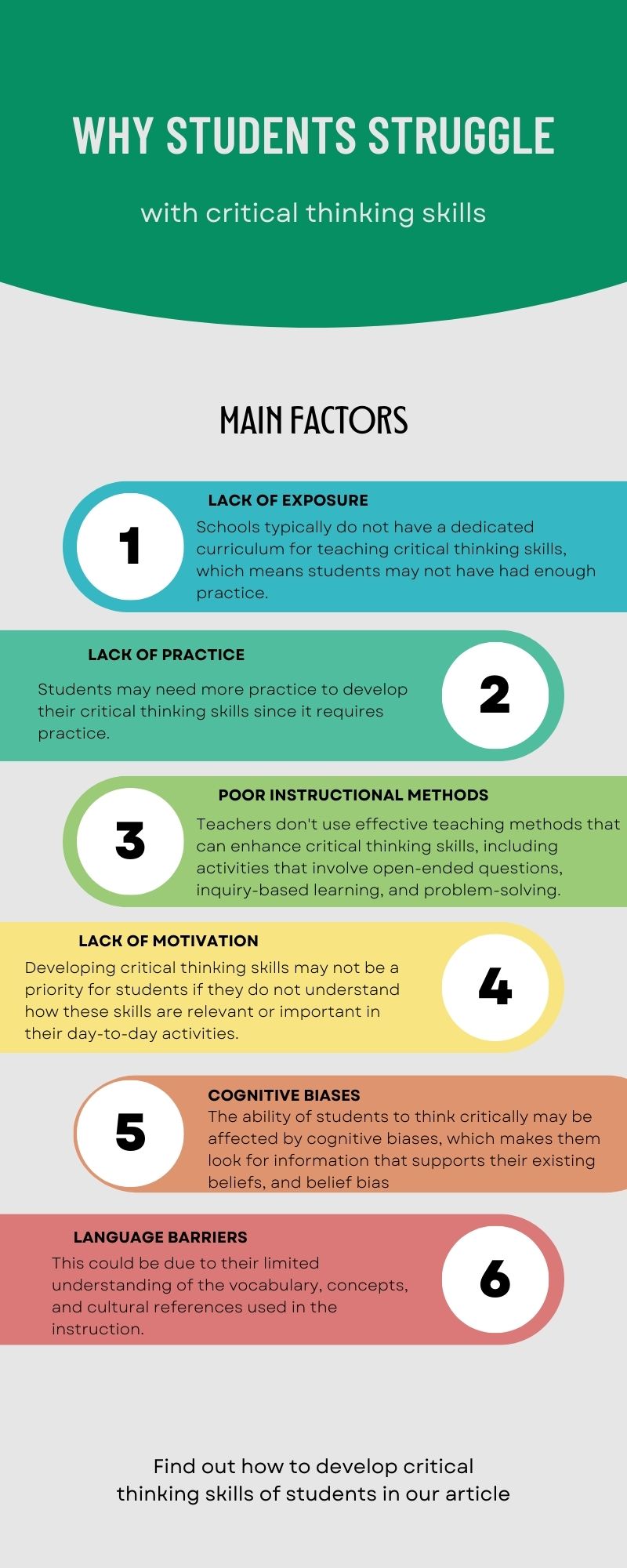
Several factors could contribute to students struggling with critical thinking skills.
- Lack of exposure. Schools typically do not have a dedicated curriculum for teaching critical thinking skills, which means students may not have had enough experience and practice.
- Lack of practice. Students may need more practice to develop their critical thinking skills since it requires doing some special exercises and tasks. This point is similar to a previous one.
- Poor instructional method. Perhaps teachers are not using effective teaching methods that can enhance critical thinking skills in students, including activities that involve open-ended questions, inquiry-based learning, and problem-solving.
- Lack of motivation. Developing critical thinking skills may not be a priority for students if they do not understand their relevance or importance in their day-to-day activities. In such cases they tend to get assistance from critical thinking writing services and get qualified solutions which meet their requirements.
- Cognitive biases. The ability of students to think critically may be affected by cognitive biases such as confirmation bias, which makes them look for information that supports their existing beliefs, and belief bias, which causes them to assess arguments based on their beliefs rather than their quality.
- Language barriers. Students who do not have a strong grasp of the language used for instruction may find critical thinking more challenging. This could be due to their limited understanding of the vocabulary, concepts, and cultural references used in the instruction.
Educators need to be mindful of possible obstacles and establish a nurturing learning setting that encourages their students’ critical thinking abilities.
How to develop critical thinking skills of students
To provide students with a high-quality education, it is important to develop their critical thinking skills. Below are some tips that can be helpful for this purpose:
Ask open-ended questions
To help students improve their critical thinking skills, try asking them open-ended questions that prompt them to analyze and evaluate information in a more detailed manner. Avoid asking questions that can be answered with a simple yes or no.
Challenge assumptions
Motivate the students to challenge presumptions and apply critical thinking when processing information. Emphasize the importance of scrutinizing information obtained from diverse sources and assessing the credibility of such sources.
Encourage curiosity
Motivate students to be curious and inquisitive by asking questions and pursuing novel ideas. Urge them to acquire new knowledge independently and to inquire when they come across new information.
Encourage problem-solving
Motivate students to exercise problem-solving skills and creativity by encouraging them to approach challenges from various perspectives and to think innovatively.
Practice reflection
Motivate students to review their own thought processes and educational experiences. Encourage them to consider what they have acquired and how they can use that knowledge in different scenarios.
Use critical thinking activities
Encourage students to enhance their critical thinking skills through various activities and exercises such as engaging in debates, analyzing case studies, and participating in group discussions.
Model critical thinking
Model critical thinking by thinking out loud when encountering new information or ideas. This will help students see how critical thinking is applied in real life.
You can assist students in enhancing their critical thinking abilities and fostering their independence by utilizing these teaching strategies.
Exercises for developing student critical thinking skills
Now, you know some tips for teachers and students on how to develop critical thinking skills, and here are some exercises that students can do in their free time:
- Analyze news articles. Students can gain a more comprehensive understanding of a topic by reading news articles and trying to identify the author’s argument, evidence, and potential biases. They can also try to compare different sources of information.
- Debate. One way to help students learn how to present a logical argument and consider different perspectives is by assigning a topic and having them debate from opposing viewpoints. They should carry out a deep research and gather evidence to support their arguments.
- Socratic questioning. Teachers can encourage students to engage in Socratic questioning by asking them a series of questions that will help them gain a better understanding of a particular concept. This will help them to think more critically and logically, and consequently develop their critical thinking skills.
- Role-playing. This activity aims to encourage students to consider the outcomes of their decisions and enhance their ability to make choices.
- Literature analysis. Students are offered to read a piece of literature and practice critical analysis, by identifying themes, symbolism and the author’s purpose, and also interpreting diverse forms of information.
- Problem-solving exercises. Students can develop their critical thinking skills by solving different problems. For instance, provide them with a real-world issue and prompt them to come up with varying solutions.
Through these exercises, students can enhance their critical thinking abilities by delving deeper into their thinking process, examining information from various standpoints, and exploring various solutions to challenges.