

If you’re ambitious about applying to Upenn’s Wharton MBA program, then your dream is to wake up in the morning to something like this:
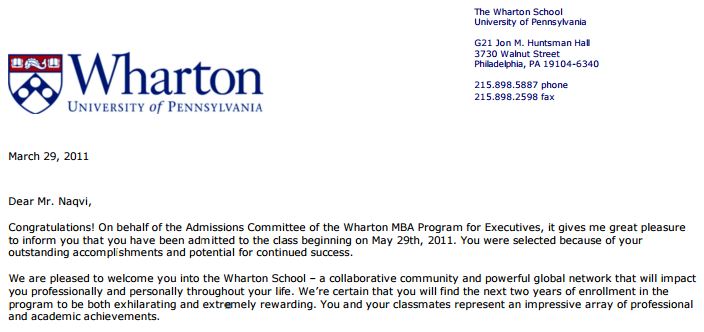
Get out of bed and see that you have received an offer from one of the top MBA programs in the world.
Keep reading if you aspire to get into Wharton and hope to receive an email similar to Naqvi’s.
This post will discuss everything you need to apply, such as GPA, GMAT/GRE, Essays, letters of recommendation, and much more.
Additionally, this post will include valuable information on letters of recommendation, scholarships, loans, and other specific information that you need to make it to Wharton.
So why should you care to read what I write?
I have mentored over 1,000 applicants (since 2012) who dreamed of making it into the top global business schools. So, I have seen everything.
Additionally, I have tutored over 15,000 individuals for the GMAT and the GREs, which are one of the pre-requisites to get into the top MBA programs.
What are Wharton’s MBA admission requirements?
Wharton (The Business School of the University of Pennsylvania) considers many factors while selecting candidates for their MBA program.
These mainly include professional maturity and diverse experience.
Wharton evaluates these traits by looking at the following aspects of your application:
- Admission Essays. (Read a sample admissions essay for Wharton here.)
- Resume
- Letters of recommendation
Before you go on further, here are some of the most salient features of the Wharton MBA program.
- Wharton Business school is located in Philadelphia, Pennsylvania, and ranks 2nd in the top MBA programs list.
- The average 2-year cost of attending Wharton MBA is $240,000.
- Numerous scholarships and fellowships are available to Wharton MBA students.
- Wharton MBA ranks as one of the top MBAs for full-time job offers.
- 94% of Wharton MBA graduates have a starting salary between $130,000 and $165,000.
- The median starting salary of Wharton MBA graduates is $150,000.
- The median signing bonus after Wharton is $30,000.
- The median Guaranteed Bonus after an MBA from Wharton is also $30,000.
Wharton Business school’s MBA program has an acceptance rate of 12%. Nearly 7,000 applicants apply to their MBA program every year, and around 900 get selected.
To get an idea of the competition, here are the acceptance rates of a few of the top MBA programs.
| Program Name | Acceptance rate |
| Stanford | 6% |
| Wharton | 12% |
| Booth | 12% |
| Harvard | 10% |
| Columbia | 19% |
Acceptance rates give you an idea about how tough it is to get in.
In the case of the Wharton MBA program, only 1 in 8 applicants makes it, which makes Wharton extremely selective.
Wharton is one of the most prestigious business schools in the world. This is not just because of its high ranking but also due to its 100,000+ Alumni that are mainly working in dominant positions.
Every applicant admitted to Wharton’s MBA program must pass through a 35-minute team-based interview and a 10-minute one-on-one interview with an admissions team member.
Although Wharton doesn’t share any official stats, nearly 40% (3,000) of all applicants are called in for the interview.
If you get called for an interview, you have a 30% chance of getting into the MBA program.
But before the interview, you must meet Wharton’s strict admissions requirements based on multiple factors. Wharton mainly looks at the following things in an applicant:
- Collaboration can be demonstrated as follows:
- College extracurricular activities include athletic participation, academic teams, clubs, and political activism.
- Academic achievements such as leading a successful group project.
- Business achievements such as developing/implementing new procedures leading special projects.
- Personal accomplishments include overcoming depression/drug abuse, honors list, leading a startup alongside a demanding full-time job.
- Analytical Chops. This can be exhibited through:
- GMAT/GRE scores.
- Nature of work experience.
- Previous GPA.
- Diploma’s/certifications such as CFA levels 1,2 and 3.
- Adaptability. Some examples can be:
- How you responded to unexpected situations.
- Taking on different roles and responsibilities.
- Changing your communication style based on who you are talking to.
- How you have constantly improved your skills
There is no guarantee that you will make it even if you checkmark on all the above factors. But, if you don’t tick mark on most of the above factors, your chances of getting in are almost none. (Unless you are Elon Musk or Mark Zuckerberg, lol)
Wharton MBA GPA Requirements
For Wharton, there is no minimum GPA to apply. However, the average GPA of admitted applicants at Wharton MBA is 3.6.
This means that Wharton wants the top of the cream. Nonetheless, your undergraduate majors and university ranking matter as well.
For instance, someone from MIT engineering with a GPA of 3.3 is far academically superior to someone, let’s say, with a 4.0 in an arts degree from Florida Memorial University. (Not to say the Florida Memorial University is wrong, lol)
Since Wharton’s curriculum is highly data-driven, you must show your analytical ability with some STEM-based undergrad courses and a high quantitative score on standardized tests.
All things aside, what to do if your GPA is low since it is impossible to change your GPA now. Some applicants think that doing a master’s with a better GPA can help you apply. Some say that one should enroll in some short courses and improve your GPA. Don’t do either of the two. Instead, if your GPA is below 3.6, focus on your GMAT/GRE to compensate.
GMAT & GRE requirements at Wharton MBA
First, Wharton has no preference for GMAT over GRE or GRE over GMAT. Therefore, you can take either the GMAT or the GRE before the application deadline to complete your application.
Wharton’s MBA Average GMAT score & Analysis
Wharton has no cutoff GMAT score, but a high score is necessary.
| Median GMAT at Wharton MBA | 740 |
| Average GMAT at Wharton MBA | 733 |
| GMAT Score Range at Wharton MBA (Unofficial) | 600-790 |
Again, this score makes Wharton Extremely Competitive for GMAT test scores.
Only 3% of the global GMAT test-takers score 740+ on the GMAT.
It usually takes 5-6 months of rigorous prep to score something above 700 on the GMAT. You may want to look at this post to get the best books to prepare for the GMAT. Or if you like to study online, then here is the best online GMAT prep course that is the most affordable.
Wharton Business school also looks at the Integrated Reasoning (IR) and analytical writing (AWA) portion of the GMAT exam.
- Excellent Integrated reasoning (IR) score for Wharton MBA is 6.5+ out of 8.
- A good GMAT AWA score for Wharton MBA is 4.5+ out of 6.
Wharton MBA GRE Score & Analysis
Wharton has no cutoff GRE score, but a high score is necessary.
| Average GRE at Wharton MBA | 324 |
Again, this score makes Wharton Extremely Competitive for GRE test scores.
Only 16% of the global GRE test-takers score 324+ on the GRE.
It usually takes 4-5 months of rigorous prep to score something above 325 on the GRE. You may want to look at this post to get the best books to prepare for the GRE. Or if you like to study online, then here is the best online GRE prep course that is the most affordable.
Here’s the breakdown of Wharton MBA GRE scores by section:
| Mean Verbal at Wharton MBA | 162 |
| Verbal Range at Wharton MBA | 150-170 |
Only 10% of all test-takers score a 162+ on GRE verbal.
| Mean Quantitative at Wharton MBA | 162 |
| Quantitative Range at Wharton MBA | 149-170 |
24% of all test-takers score a 162+ on GRE quantitative.
Wharton Business school also looks at the analytical writing (AWA) portion of the GRE.
A good GRE AWA score for Wharton MBA is 4.5+ out of 6.
Should you take the GRE or GMAT for Wharton MBA?
Wharton states that they have no preference between GRE or GMAT. However, there are a few things that you should know.
- Wharton’s average GRE score of 324 is much lower than their average GMAT score (733).
- A 324 on the GRE is equivalent to a 670 on the GMAT, a massive 63 point difference.
- 324 on the GRE corresponds to an 84 percentile, i.e., 16 percent of test-takers get this score.
- 730 on the GMAT corresponds to a 96 percentile, i.e., ONLY 4 percent of test-takers get this score.
- GRE is much easier overall than the GMAT. Math on the GMAT is much more complex, whereas Verbal on the GRE is slightly more challenging.
Therefore, since Wharton has no preference between the two exams, you must take the GRE for Wharton. You will easily be able to score a 324+ on the GRE than a 730+ on the GMAT. You will be able to prepare for the GRE in nearly half the time it would take you to prepare for the GMAT.
Multiple GMAT or GRE attempts
Multiple GMAT or GRE attempts are very common among Wharton MBA applicants. This is understandable since the scores are so competitive that many applicants don’t get a top-notch score on the first attempt.
Therefore, I recommend consulting the best prep material to ace the GMAT or the GRE.
Wharton MBA has no bias against someone who takes the GMAT or the GRE multiple times.
Multiple GRE or GMAT attempts can positively impact your Wharton MBA application. It tells Wharton’s admissions board that you are persistent and ambitious enough to work hard to improve every aspect of your application.
You could have taken the GMAT, let’s say seven times, and every time you failed to achieve a 700+. Then the 8th time, you decided to take the GRE, which is more accessible than the GMAT, and scored your desired score. This speaks volumes about your commitment and will significantly impact your application.
Also, note that Wharton MBA does not super score your standardized test scores.
This means that you cannot send section-specific scores from different exam attempts. You can only send scores in their entirety from a given shot. For example, if you have scored higher on the verbal section on your first attempt and lower on your second, you cannot choose to send the higher verbal score to your school from the first take. Instead, you will only be able to send all the scores from whichever attempt you want to report to the school.
Work Experience
The average Pre-MBA work experience at Wharton Business School is five years.
This means that the average age of an admitted MBA applicant is 27.
The range of full-time work experience for those admitted to Wharton is 1-14 years. This means that Wharton does not accept applicants without full-time work experience. Therefore, to apply to Wharton, you must have at least one year of work experience working full time after your undergraduate.
Also, Wharton does not admit applicants with more than 14 years of work experience. However, applicants with so much work experience can apply to their EMBA program.
The ideal work experience for the MBA program at Wharton is 4-5 years when filing your application. Below and above that, the odds of making it fall dramatically.
For most top MBA programs, 4-5 years is the perfect amount of work experience. According to the leading MBA forum poets and quants, this is so because five years is enough to make valuable contributions in the MBA class. In addition, these young professionals are much more adaptable and can mold into the rigorous MBA program.
The quality of work experience matters a lot in the case of Wharton. Wharton seeks individuals who have diverse backgrounds and professional maturity. You could have worked for five years in a role where you didn’t get a chance to develop your leadership skills. That work experience is futile for an MBA at Wharton.
At Wharton, just like HBS, you would see many people who previously worked at top consulting firms like Mckinsey. Nearly 25% of the Wharton class comprises people from consulting backgrounds. In a consulting firm, you can develop maturity and rigorous professional skills in a very brief period.
Undergraduate major
Nearly 40% of the MBA class at Wharton is composed of applicants from a Humanities (Liberal Arts) undergrad. Moreover, just 30% of the applicants come from a STEM background. And the remaining 30% are from a business educational background.
Unlike HBS, 70% of the admitted applicants come from a STEM background, i.e., science, technology, engineering, and math. And only 20% come from humanity, social science, and arts backgrounds.
This shows that Wharton strives to balance among all undergrad majors.
Letters of recommendation
You need two letters of recommendation (LORs) to apply to Wharton MBA.
LORs are an essential part of your application since a great letter validates your credentials and what you say in your application. A great LOR is not generic saying things like ‘this person is talented and brilliant. Everything that your referee says must be backed by actual examples. Make sure that your recommender can talk about specific things about you. Here are some examples of good LORs that you can consult for your application.
The title and credentials of your recommender are as important as what they write. Therefore, try to get references from high achievers who professionally know you exceptionally well.
What is the importance of each part of your Wharton MBA application?
Over years, we have interviewed top MBA admissions consultants and interviewed hundreds of Wharton MBA students and asked them to weigh each component of the Wharton MBA application. Here is what our studies concluded:
| MBA Admissions Factor | Importance (%) |
| GMAT Overall score | 10% |
| GMAT Quant score | 5% |
| Essays | 15% |
| Interview | 10% |
| GPA | 7% |
| Letters of Recommendation | 12% |
| Quality of Work Experience | 20% |
| Length of Work Experience | 5% |
| Work Industry | 5% |
| Quality of Undergraduate College | 4% |
| Extra-curricular | 10% |
| Undergrad majors | 2% |
Quality of work experience is the most important admissions factor at Wharton. This is because the curriculum at Wharton is extremely quantitative centric. Over 40% of admitted applicants come from finances and consulting, and have worked in banks, private equity, and top management consulting companies. Moreover, Wharton immensely values diversity in experience. Applicants who have a wide range of exposure and have developed professional maturity at an early stage have a huge edge in the application process.
Moreover, a good GMAT score and a good GPA make up almost 20% of the overall admission weight. This shows that academic and analytical aptitude is a significant factor that top MBA programs like Wharton focus on.
Also, Wharton gives a lot of weight to your extracurriculars. The reason is that Wharton is highly synergetic. Nearly all the assignments are completed in teams. Hence, the skill to cooperate, adapt and collaborate are invaluable. One can see this in the Team-Based Discussion interview format, which Wharton uses as one of the two interviews during the admissions stage.
A surprising outcome of this data is that letter of recommendation is nearly as important as the application Essays. Wharton also gives weight to LORs that come from accomplished referees. Ideally, if you get a letter from someone who knows you well (and has a strong relationship with) and has an impressive title/profile will add a lot of value to your application.
What is an Ideal applicant profile for MBA at Wharton?
So, admission decision to Wharton MBA relies on many factors.
However, based on the data and past profiles of admitted applicants, the ideal profile for getting admitted to the Wharton MBA program is as follows:
| Ideal GMAT Score for MBA at Wharton | 750+ (Quant 50 and Verbal 44) |
| Ideal GPA for MBA at Wharton | 3.65+ |
| Undergraduate Majors | ANY |
| Years of Work Experience | 5 years at the time of application |
| Type of Experience | Consulting or Financial Services |
| Ideal GRE Score for MBA at Wharton | 328+ (Quant: 166, Verbal 162) |
To have the best shot of getting into Wharton’s MBA program, you should aim for a 750+ on the GMAT or a 328+ on the GRE, with a 3.65 GPA or higher. You should have 5 years of work experience preferably in consulting or financial services.
If your profile is similar to this, your acceptance probability to Wharton MBA will be a lot more than the standard 12%.
Do keep in mind that many top-notch applicants like these ideal applicants get rejected by Wharton every year.
Female applicants have a huge advantage in the admissions process at Wharton MBA.
Wharton does not share the number of female applicants to their MBA program, but far more male applicants than female applicants for the MBA program. And since nearly 52% of all admitted applicants are females, this puts female applicants at a considerable advantage in the application process at Wharton MBA.
Application Requirements for Wharton MBA
Wharton’s MBA program requires an online application that comprises of the following:
| Online Application | Required |
| Transcript(s) | Required |
| Essay(s) | 2 Required |
| Resume | 1 Page |
| Letters of Recommendation: | 2 professional LORs |
| Interview: | 2 interviews, team based and individual |
| Application Fee: | $275 |
| Is an Application fee Waiver Available? | Yes |
| GRE or GMAT | Required |
| GRE or GMAT Waiver Available? | No |
| TOEFL/Pearson Test of English (PTE): | Required if you did not attend an undergraduate institution where the sole language of instruction is English. |
| TOEFL/Pearson Test of English (PTE) Waiver Available? | Yes |
| IETLS accepted? | No |
Deadlines and Rounds: Go here.