

The race to find a fully funded Master’s (MS) program in the United States is tougher than ever. Yet, many students still believe it’s almost impossible to get scholarships for MS-level studies—especially full funding. The truth? It is possible. You just need the right approach, profile, and willingness to apply to programs that truly align with your background.
In this blog post, we’ll explore:
- Common misconceptions about MS funding
- A real-life success story from Arizona State University (ASU)
- Key factors universities look for
- Proven tips to maximize your chances of securing a fully funded MS
Let’s dive in!
Debunking the Myths: “No Full Scholarships for MS?”
A persistent myth in many student communities is that you can’t secure full funding for a Master’s degree in the U.S. Or, if you do, it’s just a “peanuts” partial scholarship. This simply isn’t true. While it’s correct that PhD funding opportunities are generally more abundant, MS students can also unlock substantial financial support through:
- Graduate Teaching Assistantships (TA)
- Graduate Research Assistantships (RA)
- Departmental Merit Scholarships (though typically partial)
Many universities still offer full coverage of tuition fees, living stipends, and health insurance if you meet their needs and demonstrate value.
A Real Success Story: Fully Funded MS at Arizona State University
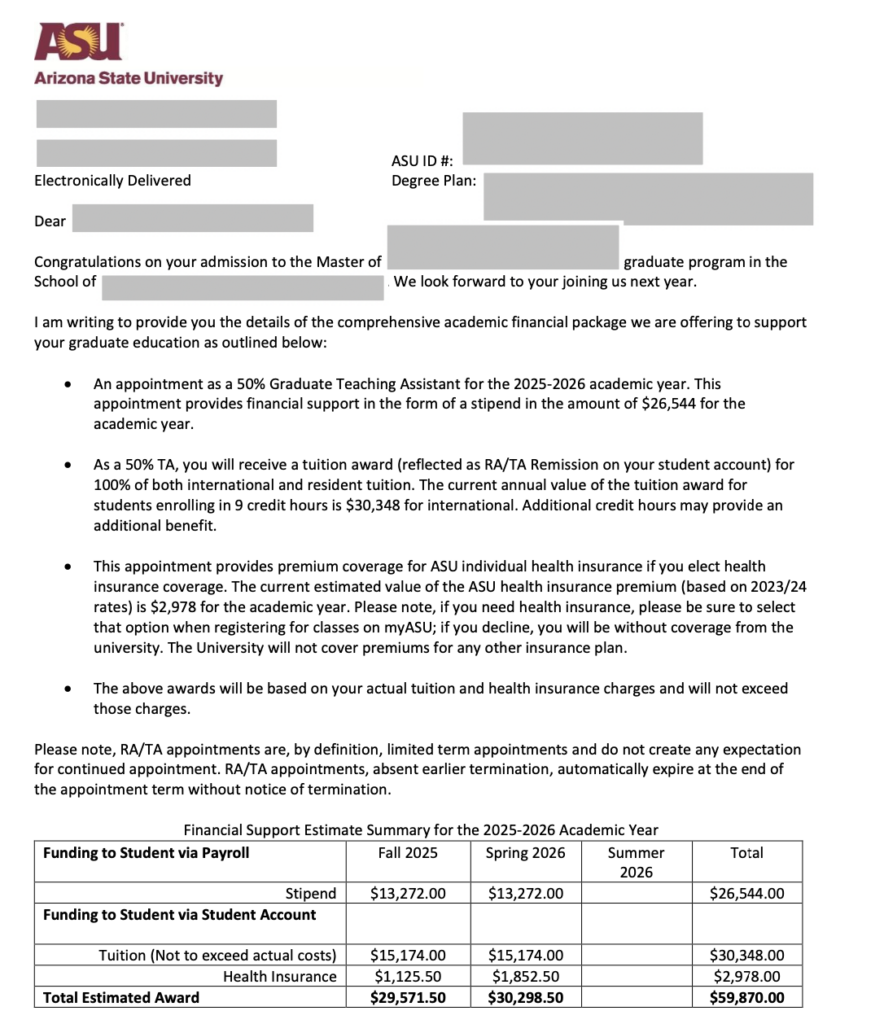
A standout example is a student who secured a 100% fully funded Master’s scholarship for a two-year program at Arizona State University (ASU). Here’s what his funding package included:
- Stipend: A weekly/biweekly paycheck totaling about $26,544 per year, covering all living expenses.
- Full Tuition Waiver: 100% of his MS tuition fees waived.
- Health Insurance: Valued at around $3,000 per year.
All in all, he received close to $60,000 per year in combined benefits—a complete “free ride,” aside from his plane ticket to the U.S.
How Did He Do It?
- Teaching Assistantship (TA): ASU offered a 50% TA appointment, which means the student works around 20 hours/week helping professors with labs, grading, and assisting undergraduate courses.
- Competitive GRE Score (Above Average): He scored a 319 overall (158 Verbal, 161 Quant, 4.0 AWA). It wasn’t 330+, but it was above the typical averages for the programs he targeted.
- Extensive Work Experience: The student had 8 years of progressively responsible, highly technical experience in a government organization. His résumé clearly showed leadership and communication skills—critical for a TA role.
Instead of applying to MIT or Berkeley—where his scores might be borderline—he carefully chose schools where his GRE scores surpassed the average range. This strategic approach got him admitted to multiple programs, with ASU offering the most generous funding.
What Universities Look for
Scholarships and assistantships aren’t given out randomly. Admissions committees want candidates who can actively contribute to their department. Here’s what they value most today:
- Technical Expertise
- Knowledge and experience relevant to the program’s curriculum.
- Proficiency in the tools, technologies, or methods the faculty uses.
- Soft Skills
- Communication, teamwork, leadership, and problem-solving abilities.
- Confidence in teaching or supporting course structures (for TA positions).
- Above-Average Test Scores
- You don’t need a perfect GRE, but being above a program’s median or average can significantly boost your profile.
- Relevant Work or Research Experience
- Even if you’re not from an academic background, highlight any real-world projects or leadership roles.
- Compelling Personal Statement
- Show how your goals align with the university’s objectives.
- Emphasize the unique skills and experiences you bring to the table.
Tips to Boost Your Chances of a Fully Funded MS
- Be Strategic with Program Selection
- Don’t chase only top-10 programs. Their competition for MS scholarships is sky-high, and they often prioritize PhD funding.
- Look at mid-tier (rank 25-60) universities where your GRE scores and profile stand out.
- Highlight Your Soft Skills
- As a TA, you’ll interact with students, grade assignments, and sometimes lead discussions.
- Show evidence of team projects, public speaking, and leadership roles in your résumé or personal statement.
- Tailor Your Personal Statement
- Carefully research the department’s priorities and professors’ interests.
- Align your experiences and career goals with what the department values (e.g., technical competencies, leadership, impact).
- Secure Strong Letters of Recommendation
- Aim for highly respected, well-known referees in your field or workplace.
- Ensure each letter is specific to your achievements, projects, and potential to excel in graduate studies.
- Don’t Underestimate Work Experience
- If you have relevant industry or government experience, spell out the key skills you gained—especially if they align with teaching or research.
- Use a detailed résumé (beyond just one page) if you’ve accumulated a variety of impactful roles and projects.
- Know When (and When Not) to Contact Professors
- While some candidates gain funding by directly emailing faculty, it’s not mandatory.
- This student applied directly through the university’s online portal without prior contact—and landed a fully funded MS.
Balancing Rankings vs. Funding
Brand-name universities (Ivy League, MIT, Stanford) are more competitive than ever. If you’re laser-focused on a top school but need funding, be prepared for:
- Higher cutoffs for GRE/GMAT and GPA.
- Few (if any) fully funded MS spots, as these schools often reserve large scholarships for PhD students.
If full funding is your priority, be open to strong programs with slightly lower rankings. These departments often have robust assistantship opportunities and actively seek capable international students to boost their own reputation and future alumni network.
Key Takeaways
- MS Scholarships Do Exist: It’s a myth that Master’s students can’t get 100% funding.
- Target the Right Programs: Compare your GRE scores and experience with each university’s average to increase acceptance and funding odds.
- Showcase Both Hard & Soft Skills: Great TAs and RAs need more than just technical know-how; communication and leadership matter a lot.
- Strong References Are Powerful: Letters from high-profile referees who genuinely know your capabilities can tip the scales in your favor.
- Consider Mid-Tier Schools for Full Funding: Compromising slightly on ranking can open the door to extensive scholarship packages.
Final Thoughts
Securing a fully funded MS scholarship is absolutely within reach if you’re strategic. This success story at Arizona State University is proof that you don’t need a 330+ GRE score or an Ivy League tag to get a full ride. What you do need is a targeted approach to:
- Pick the right universities
- Emphasize your unique blend of technical and soft skills
- Craft impactful applications and gather specific recommendation letters
So, if you’ve been hesitating because you think you can’t afford a Master’s degree in the U.S., think again. Roll up your sleeves, research the programs where you’ll truly stand out, and start applying!
Have Questions?
If you need more clarity on applying for MS scholarships, GRE score requirements, or tips for a winning personal statement, feel free to drop your questions in the comments below!